AI SRE + Observability Brands — AI Overview Position Reality & Market Analysis
A data-driven audit of 20 observability and AI SRE brands. For every commercial term each brand claims on its own pages, we measured whether Google's AI Overview actually cites the brand for that term — or hands the answer to someone else. This report is a proof of concept: AI-visibility research can produce defensible content priorities, not guesses.
What the data says
Eight numbers from the study, ordered by what a Head of Marketing or Head of Content should worry about first.
The market is not AEO-optimized
The observability & AI SRE category has fully migrated to AI-answer search — 94.5% of its commercial vocabulary triggers an AI Overview. The vendors have not migrated with it. Their websites still read like 2018 SEO product pages. The measurement below is the direct consequence.
Where every brand claim lands, across the industry
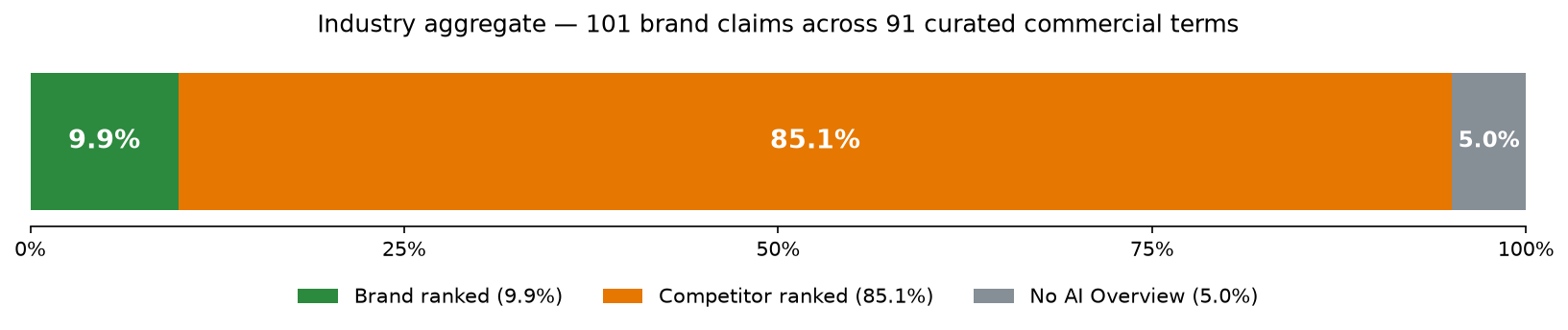
The 85% competitor-ranked share is not a per-brand failure — it is a category-level failure. When an observability brand claims a commercial term on its website, roughly nine times out of ten the AI Overview hands the answer to a different source. The vocabulary is real, the buyer demand is real, and the answer engine is real. What is missing is content that AI Overviews will cite.
The per-brand distribution
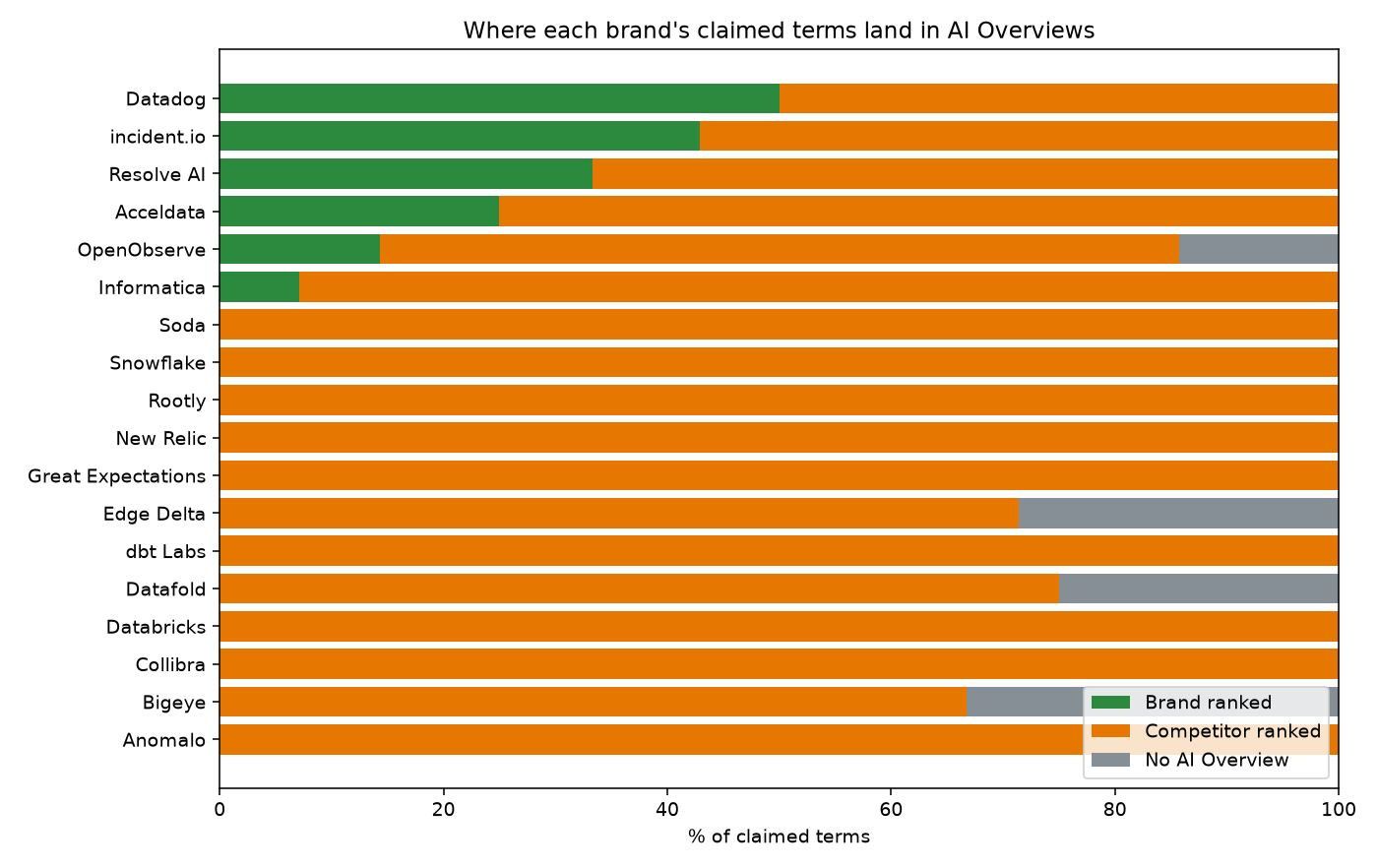
Note: 2 of the 20 corpus brands (Atlan, Metaplane) claim zero of the 91 curated commercial terms and don't appear on this leaderboard. Their positioning language sits entirely outside the buyer-research vocabulary — that absence is its own finding.
Datadog leads — the brand ranks on 50% of its six claimed terms. Incident.io is second, ranking on 42.9% of its seven claimed terms. These are the only two brands in the study that ship product-page content the AI Overview consistently agrees with. The other sixteen either don't rank at all, or rank on a small fraction of what they claim.
Every term, placed by demand and claim count
Why this matters, in one line
- 94.5%of curated commercial terms trigger an AI Overview. Buyer research has moved.
- 85.1%of brand claims are answered by a competitor. The move has left vendors behind.
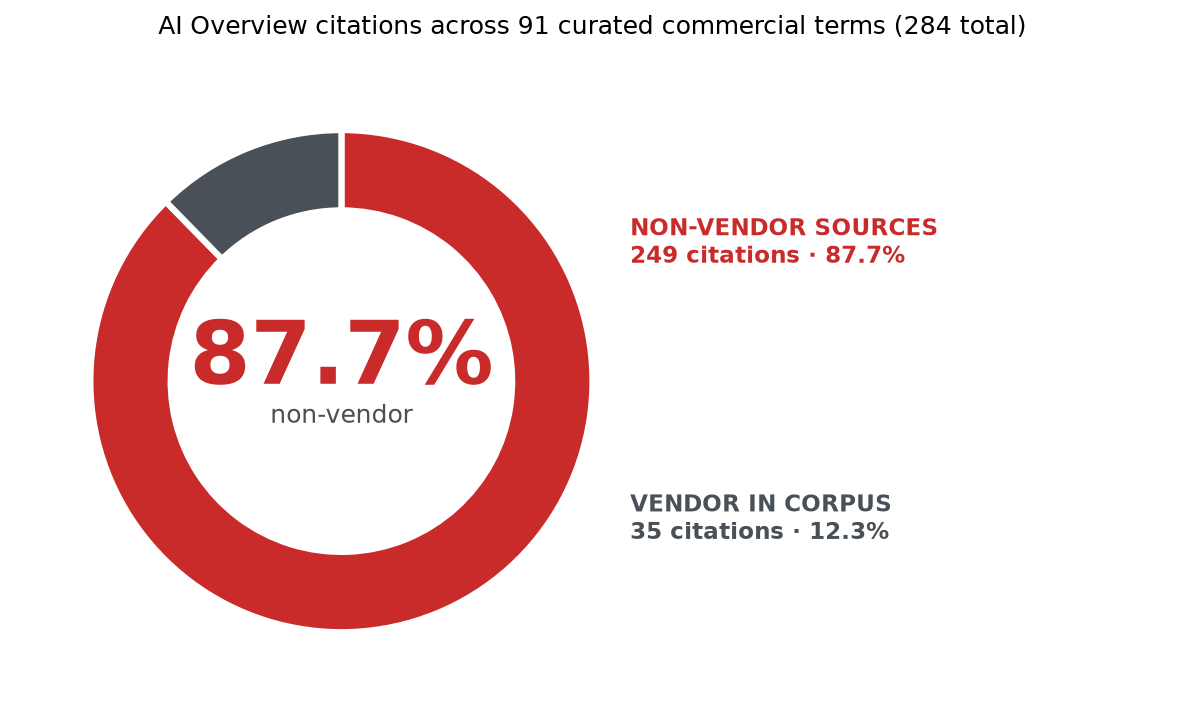
- 87.7%of citations that do land go to non-vendor sources. The vendor category has ceded its own answer space.
The invented-category disconnect
Brands invent categories to sound differentiated on their homepage. But every invented category is also a search term buyers might type. When they do, an AI Overview almost always triggers — and the brand that coined the term is cited almost never. This is the argument for why branding strategy and AEO strategy have to be built together, not sequentially.
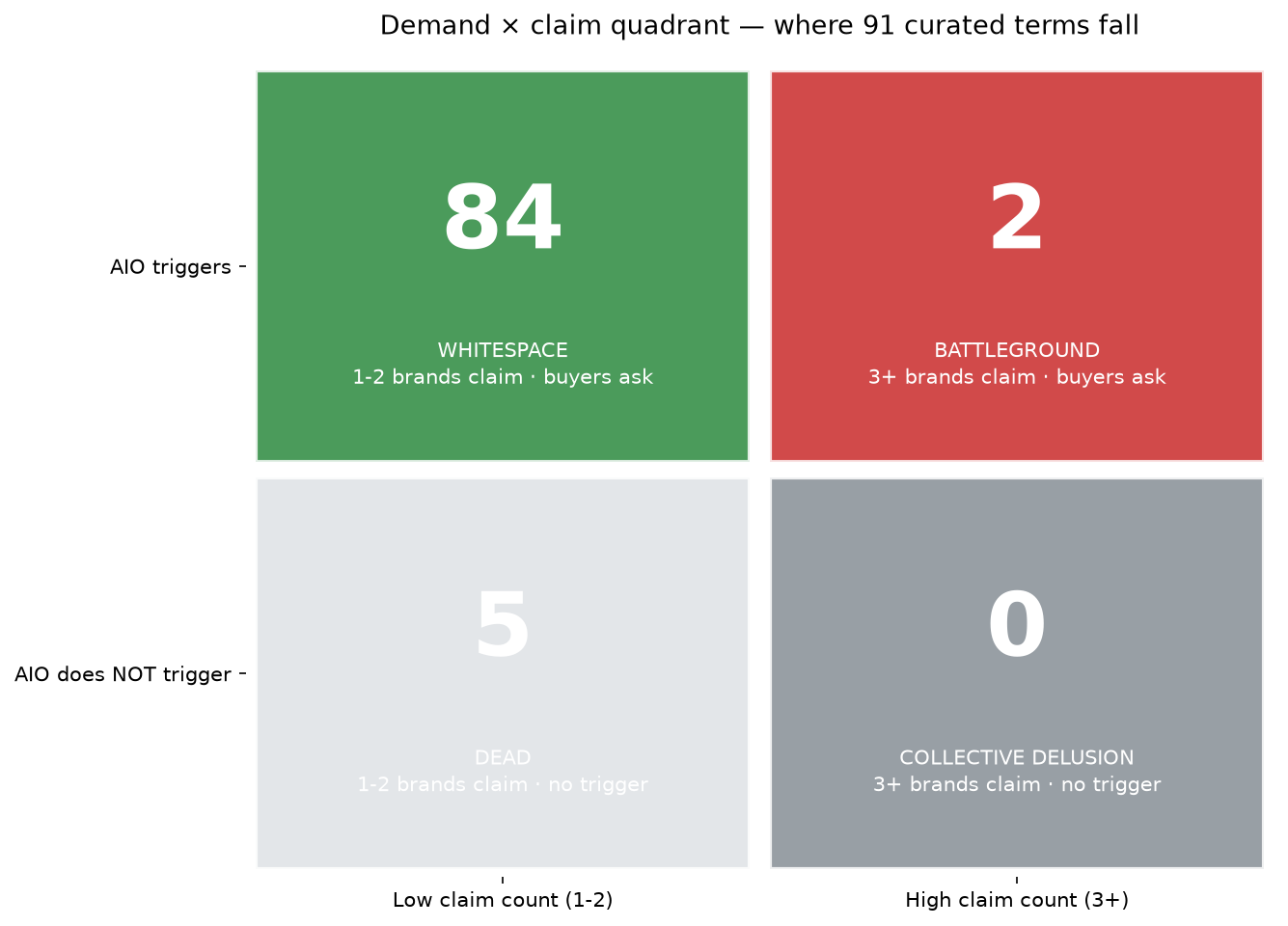
- 84 / 91terms in the study are claimed by exactly one brand — invented vocabulary, not shared category.
- 94%of those invented terms trigger an AI Overview. Buyers do research them.
- 8%is the rate at which the coining brand is cited when the AIO fires. The other 92% goes to someone else.
- 5 termsare pure noise — no AI Overview, no buyer research. Vocabulary the industry echoes to itself.
What "someone else answers" looks like — one worked example
incident.io coined "incident response" as core positioning. When a buyer types incident
response into Google today, the AI Overview cites cisa.gov (US federal cybersecurity),
huntress.com (security vendor from an adjacent category), and ibm.com (generic
knowledge base). The vendor whose homepage opens with that phrase is not in the answer.
The dead-vocabulary shortlist
Five terms in the study have zero AI Overview trigger — coined by a single brand, ignored by every buyer. These are pure branding-side inventions that produced no measurable search demand.
| Coined term | Coined by | Business relevance |
|---|---|---|
| telemetry-native AI SRE | Edge Delta | 93.3 |
| Intelligent Telemetry Pipelines | Edge Delta | 93.3 |
| Dependency Driven Monitoring | Bigeye | 93.3 |
| AI-era observability | OpenObserve | 63.3 |
| costly data quality issues | Datafold | 80.0 |
The Qwen-scored "business relevance" of these terms is high — 93.3 out of 100 for three of them — because the vocabulary reads like something a buyer would type. But nobody does. The rubric measures whether a term sounds buyer-relevant. AI Overview trigger data measures whether it is. That gap is the branding-vs-AEO disconnect, quantified.
Who's inventing the most vocabulary — and losing it
Per-brand breakdown of solo-claimed vocabulary and what happened to it in AI Overviews. Column headings: Claims = solo-invented terms this brand owns. Won = brand ranks in the AIO for that term. Lost = AIO triggers but a competitor / generic source wins the citation. Dead = no AIO triggers at all.
| Brand | Solo claims | Won | Lost | Dead |
|---|---|---|---|---|
| Informatica | 14 | 1 | 13 | 0 |
| Soda | 8 | 0 | 8 | 0 |
| New Relic | 7 | 0 | 7 | 0 |
| Snowflake | 7 | 0 | 7 | 0 |
| Edge Delta | 6 | 0 | 4 | 2 |
| OpenObserve | 6 | 1 | 4 | 1 |
| incident.io | 5 | 2 | 3 | 0 |
| Datadog | 5 | 2 | 3 | 0 |
| Rootly | 5 | 0 | 5 | 0 |
| Acceldata | 4 | 1 | 3 | 0 |
Two shapes emerge. Informatica, Soda, New Relic, Snowflake, and Rootly invent heavily and win nothing — vocabulary produced for the homepage, unsupported by content the AI answer engine can cite. Edge Delta produces two dead terms (no buyer research at all), which is worse than losing — it means the coining effort didn't even reach a search box. incident.io and Datadog are the outliers who win any of their invented vocabulary at all, and each wins only 2 of 5. Nobody in this study wins more than 40% of what they coin.
YouTube — a channel to invest in
When the observability + AI SRE category loses an AI Overview citation to a non-vendor, it usually loses to YouTube or IBM. The pattern is unambiguous and repeats across the top 15 non-vendor winners. What's more interesting is that most vendors in the study already have a YouTube channel — they just don't publish the kind of content that gets cited.
Who wins the industry's contested AI Overview share
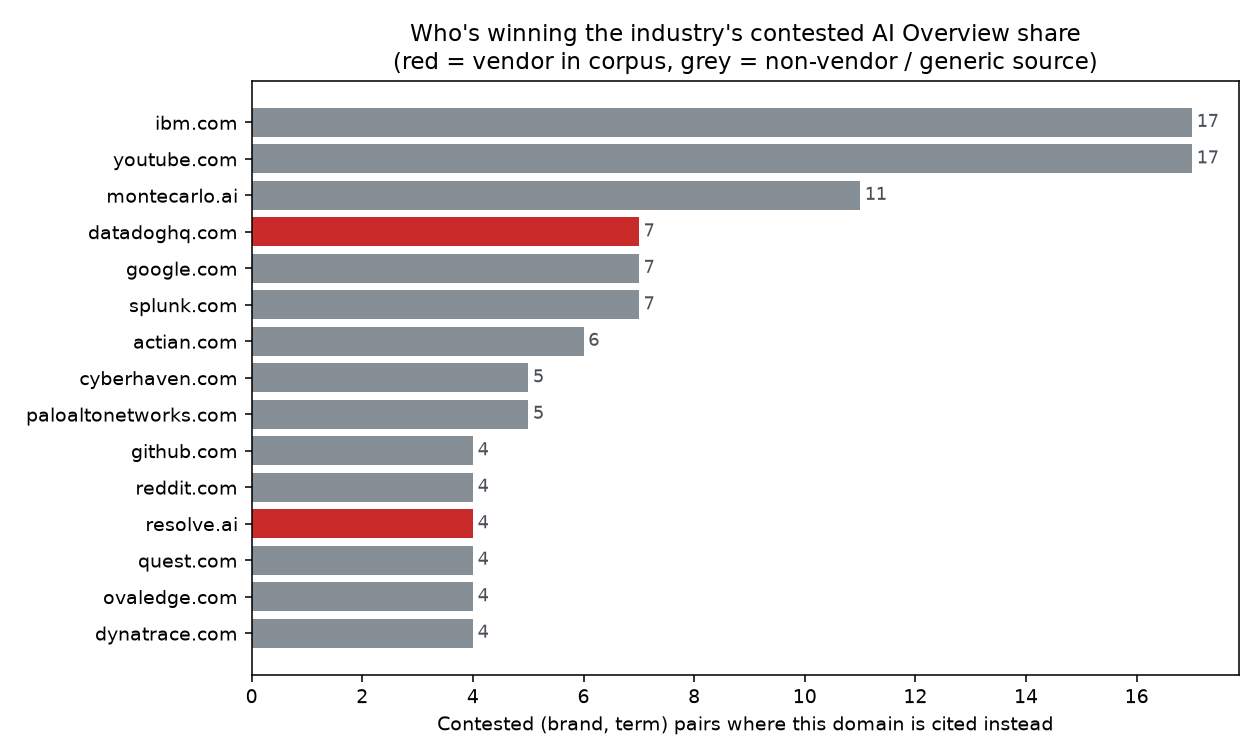
- 17 · 17IBM and YouTube tied for #1. Both non-vendor.
- 7Datadog — the top-ranking vendor. Loses the tie by more than 2×.
- 11 of 15top winners are non-vendor sources. Only 4 vendor domains crack the leaderboard.
- 4Reddit still ranks in the top 15 even after the August 2026 Google update that decimated forum visibility across most categories.
Every vendor already has a YouTube channel. Almost none publish for AI Overviews.
A quick audit of the brands in the study:
| Channel | Subs (approx) | Content pattern |
|---|---|---|
| @Databricks | ~100k | Tutorials, listicles, branded and non-branded info content. The only channel in the study actively producing content the AI answer would cite. |
| @DatadogHQ | ~30k | Almost every video is brand-centric — product launches, customer stories. No topical explainer content. The channel isn't optimised for AEO discovery. |
| @EdgeDelta | small | Product demos, comparison videos. Low volume, brand-only. |
| @incident-io | small | Product-centric. Occasional practitioner interviews. |
| @acceldatainc | small | Webinar recordings. No topical explainer. |
| @AnomaloAi | small | Product walkthroughs, minimal reach. |
A quick glance at either of the largest two channels tells the story: the top-viewed video on both Databricks and Datadog is a variant of "What is observability?" or "What is a lakehouse?". The single most-watched thing on each brand's channel is the piece of explainer content Google is already citing. Neither brand is producing more of it deliberately.
Why explainer format still wins, three years in
For the entire time I worked on SEO at Edge Delta, the pages that ranked in classic Google search for commercial terms were blog posts — not product or use-case pages. The AI Overview era hasn't changed that pattern, it has amplified it. What changed is the format the answer engine now expects: a definitional intro, followed by a comparison section, followed by an FAQ. Blogs already written that way get cited. Product pages don't get cited at all.
The dirty solution — a 10-day test
A short-term hack for enterprise brands unwilling to rewrite product pages: embed sales-qualifying CTAs inside the explainer content that already ranks. incident.io's blog post on the AI SRE definition ranks in both the classic SERP and the AI Overview — but the first fold contains no demo CTA, no lead-capture form, no in-content "book a call" link. A purely awareness-driven visitor with no conversion path.
A single 10-day test — add a first-fold demo CTA to the top three AIO-ranking blog posts, measure demo conversions — is the fastest way to determine whether AEO-earned traffic behaves like SEO-earned traffic for a given brand. Small effort, disproportionate signal, and the result answers a much bigger question: is search truly a helping-hand channel for this brand, or is it a real acquisition channel that has been under-instrumented?
Two paths — Datadog vs incident.io
The two brands with real AI Overview fidelity in this study take almost opposite paths to get there. Datadog covers every category surface with a product line — and still ranks in the AIO for only three of six terms. incident.io targets one narrow cluster (incident response & AI SRE) — and ranks in the AIO for three of seven. The comparison is the argument for targeted semantic map optimisation over broad category coverage.
Datadog
Broad category coverage · every product surface, everywhere- 6claimed terms in the 91-term study
- 3brand ranks in AI Overview (50%)
- 3competitor ranked instead
- 7times cited across the whole industry — trails IBM (17) and YouTube (17)
Where Datadog ranks
- Observability Pipelines
- Observability Platform
- Cloud Cost Management
Where Datadog loses the citation
- AI-Powered Observability and Security
- Security and Observability → Cisco, Dynatrace, Huntress
- DevSecOps → IBM, GitLab, Red Hat, YouTube
incident.io
Narrow semantic cluster · incident response + AI SRE, nothing else- 7claimed terms in the 91-term study
- 3brand ranks in AI Overview (42.9%)
- 4competitor / no answer
- 97.1avg business relevance score of its claimed terms — highest of any brand
Where incident.io ranks
- incident management platform
- incident management software
- AI SRE
Where incident.io loses the citation
- end-to-end incident management
- incident response → CISA, IBM, Huntress, SANS
- agentic root cause analysis
- AI-powered incident summaries
The read: targeted semantic map beats broad product surface
Both brands land in AI Overviews at roughly the same rate (50% and 43%). Both are the industry-leaders at what they do (Datadog by scale, incident.io by focus). But the cost of that fidelity is completely different. Datadog produces content across the entire observability + security stack and lands in three answers. incident.io produces content in one narrow neighbourhood and lands in three answers — with a 97.1 average business-relevance score on those terms, the highest of any brand in the study.
For a client with a fraction of Datadog's marketing headcount, the incident.io pattern is the only replicable one: pick a narrow semantic cluster, own every term within it end-to-end, resist the urge to expand until every high-relevance term in the cluster is either won or actively being contested. That's what "targeted semantic map optimisation" means in practice, and this section is the two-brand exhibit for it.
Non-vendor share of voice
Across all 91 curated commercial terms — the vocabulary these 20 vendors coined and put on their own product pages — Google's AI Overview cites non-vendor sources 87.7% of the time. The entire vendor category has effectively ceded its own answer real estate.
Who's picking up the citations vendors won't
The top 15 non-vendor domains ranked by citation count across the 91-term study:
| Rank | Domain | Citations | What it publishes |
|---|---|---|---|
| 1 | youtube.com | 19 | Vendor and independent tutorials; explainer video is the format AIO prefers for "what is X" queries |
| 2 | ibm.com | 15 | The IBM knowledge base — encyclopedic definitions of every observability, security, and data term |
| 3 | montecarlo.ai | 6 | Ex-corpus data observability vendor; still cited on data-quality terms via its resource centre |
| 4 | dynatrace.com | 6 | Adjacent-category APM vendor; ranks on security/observability crossover terms |
| 5 | google.com | 5 | Google Cloud docs; wins on cloud-cost / cloud-native terms |
| 6 | splunk.com | 5 | Adjacent SIEM vendor with strong resource-page SEO history |
| 7 | paloaltonetworks.com | 5 | Security incumbent; wins on incident-response / security cross-references |
| 8 | reddit.com | 4 | Practitioner discussion threads; still ranks post-August-2026 update for niche technical queries |
| 9 | actian.com | 4 | Data-management vendor; wins on data-integration / lineage terms |
| 10 | ovaledge.com | 4 | Data governance vendor with a heavy explainer-blog strategy |
| 11–15 | github.com · cyberhaven.com · linkedin.com · wiz.io · microsoft.com | 3 each | Mix of security vendors and platform giants |
Two patterns in one leaderboard
The top-10 non-vendor list breaks cleanly into two groups. Explainer platforms — YouTube, IBM, Reddit, GitHub — win when the query is definitional. Adjacent-category vendors — Dynatrace, Splunk, Palo Alto Networks, Cisco (below top 15) — win when the query straddles two categories that the corpus brands have chosen to differentiate against but not to publish about.
Per-brand visibility scorecard
Every brand in the study reduced to four numbers and one name. Opportunity = claimed terms where an AI Overview actually triggers (the answer surface is there to be won). Actual = the brand is cited. Landed = actual ÷ opportunity. Losing to = the domain most often cited on this brand's contested terms.
| Brand | Opportunity | Actual | Landed | Losing most often to |
|---|---|---|---|---|
| Informatica | 14 | 1 | 7.1% | accesscorp.com · atlan.com · claravine.com |
| Soda | 10 | 0 | 0.0% | ibm.com (4) · youtube.com (4) · montecarlo.ai (3) |
| incident.io | 7 | 3 | 42.9% | cisa.gov · huntress.com · ibm.com |
| Rootly | 7 | 0 | 0.0% | augmentcode.com · clickhouse.com · datadoghq.com |
| New Relic | 7 | 0 | 0.0% | clickhouse.com · datadoghq.com · github.com |
| Snowflake | 7 | 0 | 0.0% | paloaltonetworks.com (2) · crashplan.com · informatica.com |
| Datadog | 6 | 3 | 50.0% | blackduck.com · gitlab.com · ibm.com |
| OpenObserve | 6 | 1 | 16.7% | datadoghq.com (2) · motadata.com (2) · youtube.com (2) |
| Edge Delta | 5 | 0 | 0.0% | resolve.ai (2) · augmentcode.com · clickhouse.com |
| Great Expectations | 5 | 0 | 0.0% | montecarlo.ai (3) · actian.com (2) · ibm.com (2) |
| Acceldata | 4 | 1 | 25.0% | acm.org · biomedit.ch · github.com |
| Anomalo | 4 | 0 | 0.0% | — |
| Resolve AI | 3 | 1 | 33.3% | apple.com · google.com · youtube.com |
| dbt Labs | 3 | 0 | 0.0% | ibm.com (2) · youtube.com (2) · actian.com |
| Datafold | 3 | 0 | 0.0% | actian.com (2) · gartner.com · getcollate.io |
| Bigeye | 2 | 0 | 0.0% | ibm.com (2) · montecarlo.ai (2) · youtube.com (2) |
| Collibra | 2 | 0 | 0.0% | cyberhaven.com (2) · datahub.com · dataversity.net |
| Databricks | 1 | 0 | 0.0% | — |
Three groups fall out of the same number
Category-inventors (0% landed). Twelve brands claim commercial vocabulary and land in zero AI Overviews. Includes both the AI SRE cluster (Edge Delta, Rootly) and the data-quality cluster (Soda, Anomalo, dbt Labs, Great Expectations, Datafold, Bigeye). Each of these has coined vocabulary without producing the content to defend the answer slot.
Selective winners (25-50% landed). Six brands land in some AIOs. incident.io and Datadog top the list at 42-50%; Resolve AI and Acceldata cluster in the 25-33% range; OpenObserve and Informatica trail. Every one of them wins on narrowly-scoped terms and loses on broader ones — a consistent pattern across the whole scoreable population.
Under-instrumented (opportunity=1 or 2). Databricks, Collibra, Bigeye. Small footprint in the study means small denominator — not necessarily a marketing failure. The signal these brands would want to measure is outside the 91-term set (their real vocabulary sits in the terms we filtered out as too-branded or non-commercial). Which is itself the finding for those brands: their positioning language isn't the commercial vocabulary buyers type.
What this changes for content strategy
The argument this report makes: for enterprise B2B SaaS with long sales cycles and multi-stakeholder buying, AI visibility research is a stronger foundation for content strategy than classic SEO keyword research. Below is why the numbers in this study support that, and what a client engagement built on this framework would actually look like.
Why AI visibility beats classic SEO for this buyer profile
Classic SEO keyword research tells you which terms have volume. It does not tell you which stakeholder types the term, what pain the term signals, or whether the answer engine will cite a vendor for it. For a Datadog-scale purchase decision — 5-figure ACV minimum, five stakeholders across SRE / Platform / Security / Finance / Engineering Leadership, 6-12 month evaluation cycle — knowing "this term has 8,100 monthly searches" is a start, not a plan.
Every term in this study was scored against a published rubric on four dimensions before it was measured for AIO visibility:
- ICP0-3 relevance to core buyer personas (SRE / Platform / Data Eng / DevSecOps / Data Leader)
- Pain0-3 strength of the business problem the term signals (downtime cost → buzzword)
- Stakeholder0-3 seniority of who types it (IC engineer → evaluator → budget-owner)
- Commercial3 or 1 (deterministic — buyer-research query vs. definitional query)
That is four extra dimensions before you write a single word. Every content decision that comes out of this framework maps to a specific stakeholder in the buyer committee, a specific pain the term describes, and a specific lifecycle stage (definitional at the top, commercial at the bottom). That's how you turn "we should rank for observability" into "we should rank for the four AI-SRE-adjacent buyer terms our Platform Lead persona types at the evaluation stage, and here are the three IBM pages we'd need to displace on each."
What a content plan built from this framework contains
Three things classic SEO keyword lists don't have:
- Stakeholder mapping per term. Every term in the plan is tagged to the persona likely to search it. Marketing knows whether the piece is written for the IC evaluator or the budget-owner. This is impossible from a bare keyword list.
- Business-relevance weighting. A term at Pain=3, ICP=3, Stakeholder=3 gets 20× the attention of a term at Pain=1. This maps content investment to buying-committee value, not to monthly search volume. Search volume is downstream of business value in this market; buyer intent isn't.
- Answer-engine format guidance. The domain currently cited on each term is the format the AIO expects. "IBM cites for this term" → publish an encyclopedic explainer with a definition-first structure. "YouTube cites for this term" → publish a video-first companion. "A security vendor cites for this term" → the AIO believes this is a security query even if you sell into observability; the strategic call is whether to fight the framing or accept it. None of this signal is available from keyword volume alone.
How this scales beyond a single report
This report analysed 20 brands, 91 terms, 284 AIO citations. Every step — profile extraction, term deduplication, DataForSEO pulls, Qwen classification, priority quadrant — is fully reproducible from the source repo. Running the same pipeline against a new brand corpus (payments, cybersecurity, dev tooling) takes days, not weeks, and produces the same kind of stakeholder-mapped, pain-scored, AIO-measured content plan for that market. This report is the model. The next application is a client engagement.
Two applied examples
Two clusters from the study, run through the framework end-to-end. Each cluster is a coherent slice of vocabulary a client might realistically own. The point: this is the shape of the deliverable a client engagement would produce for a term set of their choosing.
Cluster 1 — Data Quality Automation
12 terms in the study cluster around data quality tooling and automation.
- 11 / 12terms trigger an AI Overview — buyer demand proven
- 0terms are ranked by the claiming brand (Soda, Great Expectations, Anomalo, Datafold, Informatica all lose)
- 86.7avg business relevance of the cluster — high ICP, high pain, evaluator-level
- Losing toIBM, YouTube, montecarlo.ai (ex-corpus), actian.com
| Term | Claimed by | Relevance | AIO status |
|---|---|---|---|
| Data Quality Platform | Datafold · Great Expectations | 93.3 | Competitor ranked |
| data quality solution | Great Expectations | 93.3 | Competitor ranked |
| end-to-end solution for data quality | Great Expectations | 93.3 | Competitor ranked |
| automated data quality monitoring platform | Anomalo | 93.3 | Competitor ranked |
| Automated Record-level Resolution | Soda | 93.3 | Competitor ranked |
| data quality issues | Soda | 80.0 | Competitor ranked |
| data quality framework | dbt Labs · Great Expectations | 80.0 | Competitor ranked |
| data quality and observability | Informatica | 80.0 | Competitor ranked |
| data integrity issues | Informatica | 80.0 | Competitor ranked |
| AI-native Data Quality | Soda | 70.0 | Competitor ranked |
| data quality tests | Great Expectations | 63.3 | Competitor ranked |
| costly data quality issues | Datafold | 80.0 | No AI Overview |
Cluster 2 — Data & Systems Observability
10 observability-platform terms in the study — the core category vocabulary of the entire market.
- 9 / 10terms trigger an AI Overview — the category has fully migrated to AI-answer search
- 3 / 10wins across the corpus — Datadog (Observability Platform), OpenObserve (full-stack observability, unified observability partial)
- Strong ICPSRE / Platform Engineering across every term. Every buyer in this study touches this vocabulary.
- Content gaphigh citation activity but 7 of 10 terms answered by competitors or generics
| Term | Claimed by | Relevance | AIO status |
|---|---|---|---|
| Observability Platform | Datadog · OpenObserve | 90.0 | Brand ranked |
| full-stack observability | OpenObserve | 93.3 | Brand ranked |
| Data Observability | Bigeye · Soda | 93.3 | Competitor ranked |
| Enterprise Data Observability | Acceldata | 93.3 | Competitor ranked |
| Real-Time Observability | Acceldata | 100.0 | Competitor ranked |
| unified observability | OpenObserve | 83.3 | Competitor ranked |
| Intelligent Observability | New Relic | 100.0 | Competitor ranked |
| All-in-one observability platform | New Relic | 90.0 | Competitor ranked |
| AI-Powered Observability and Security | Datadog | 100.0 | Competitor ranked |
| AI-era observability | OpenObserve | 63.3 | No AI Overview |
What a client would take from this report
Two clusters, run in about a day of pipeline time, produce a defensible content roadmap for two distinct product surfaces. The same pipeline extended to a specific client's brand + top 3 competitors produces a bespoke version of the same analysis for their exact term set. That's the model this report proves out — and the offer it makes visible.